AI Search Is Changing the Way People Find Information
For many years, the sole objective for most businesses has been to secure the top spot in Google’s search engine results. The importance of good SEO practices in the form of keyword use, backlinks and website optimisation would ensure that enough traffic was driven towards the website to produce leads. Although the basics remain important, the manner in which searches are conducted is changing rapidly.
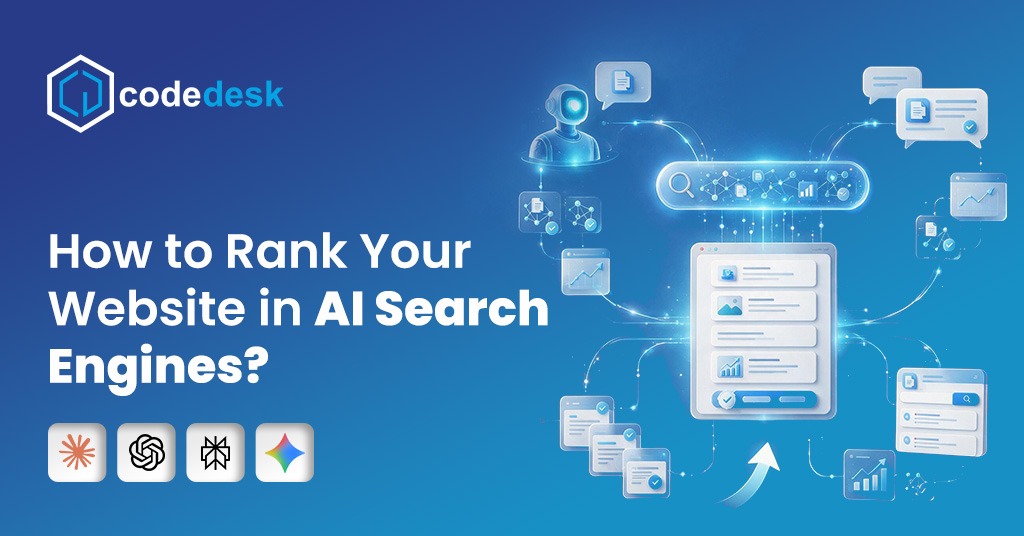
Today, millions of internet users are utilising AI-driven platforms like ChatGPT, Claude, Perplexity and Google Gemini to receive answers to questions without having to navigate multiple websites. As opposed to presenting the user with search results, the technology is able to generate direct answers by analysing and summarising information present on reliable websites online.
The rise of such platforms has brought about changes in the digital marketing landscape as well. In addition to ensuring that the website performs well in search engines, businesses now need to make sure that the content created is good enough to be included in AI search engines.
If your website isn’t being included in AI results, then you are definitely missing out on huge opportunities.
What Is AI Search?
AI search represents an innovative approach to information searching online with the help of artificial intelligence instead of the regular results that are provided by search engines. Instead of providing users with tens of links, AI platforms provide an answer by using the information from several reliable sources.
For instance, if the question is:
“How does a small business boost its SEO in 2026?”
A regular search engine will show you web pages that might have an answer.
In contrast, an AI search platform will analyze credible content available online and present one structured answer. In most cases, it will also provide the names of websites which served as the source of this answer.
Traditional SEO vs GEO
Search engine optimization (SEO) continues to be an integral component of any digital marketing campaign. This technique is useful in ensuring that search engines comprehend your site, improves ranking, and generates more organic traffic.
Nevertheless, AI searches come with an additional level of optimization referred to as Generative Engine Optimization (GEO). While SEO aims at increasing your visibility through search engine optimization, GEO is about making your content comprehensible by the AI engine.
The differences are significant.
| Traditional SEO | Generative Engine Optimisation (GEO) |
| Targets search engine rankings | Targets AI-generated answers |
| Focuses on keywords | Focuses on topics, entities and expertise |
| Measures clicks and rankings | Measures visibility and AI citations |
| Optimises for search algorithms | Optimises for machine understanding and content extraction |
Rather than replacing SEO, GEO builds on it. Businesses that combine both strategies are better positioned to reach audiences regardless of whether they use Google Search or AI-powered assistants.
Why Ranking Number One on Google Is No Longer Enough
Businesses think that if they are number one on Google, then they are bound to show up in the responses generated by AI technology.
This is definitely not true.
AI technologies analyze content differently. Instead of looking at rankings, they take into consideration other factors like clarity, structure, authority, facts, and utility.
Even if a page ranks well due to good backlinks, but it is neglected if it:
- • Buries the answer beneath lengthy introductions.
- • Lacks credible evidence or supporting data.
- • Is poorly organised.
- • Contains outdated or inaccurate information.
- • Demonstrates limited expertise on the topic.
However, an excellently written article by an acknowledged authority on the matter could be chosen by the AI system even if this particular piece of writing is not ranked at the top in regular searches.
Therefore, corporations must reconsider their content production techniques and start writing articles taking into account not only human audience but also AI that evaluates the material.
Why AI Visibility Matters for Businesses
Being used in answers provided by AI is not only about extra visitors to your site; it also enables you to become perceived as an authority in your industry.
The more often users encounter your information being used as a source of reliability and expertise in AI answers, the higher chances are for them to develop trust in your brand. And all of this may be achieved without ever visiting your site.
If we speak about competitive industries, this is a great chance for businesses to get ahead of the competition and use this technology to their advantage.
How Do ChatGPT, Claude, Perplexity and Gemini Choose Content?
Knowing how AI platforms assess the content is the first step you need to take in order to improve your visibility. Even though all the platforms use their own technologies and methods of retrieval, there is one thing that unites all of them – their preference for the content which is correct, well-organized, trustworthy and understandable.
Unlike other ranking factors which include keyword density and backlinks, AI platforms will analyze the content of a webpage as a whole and decide if it answers the user’s question reliably enough.
Let us take a closer look at how the best-known AI search platforms assess the content.
ChatGPT
ChatGPT has emerged as one of the most popular AI assistants of the world for conducting research, solving problems, and providing business guidance. If web searching is possible, it uses both its language model and credible online sources for formulating informative answers.
In order to increase the probability of having your content cited in ChatGPT, you should try making pages that answer queries concisely. Introduction of a page that delays the point unnecessarily could confuse AI about the information it is supposed to provide.
ChatGPT tends to favour content that includes:
- • Clear, concise answers near the beginning of each section.
- • Logical heading structures using H2 and H3 tags.
- • Comprehensive coverage of a topic.
- • Credible statistics and supporting evidence.
- • Strong author and business credibility.
- • Consistent brand mentions across reputable websites.
The goal is to make every section of your content understandable on its own, allowing AI to extract useful information without additional interpretation.
Perplexity
Perplexity works differently from many AI assistants because it openly cites the sources used to generate its responses. This makes authority and factual accuracy especially important.
Content that performs well in Perplexity often shares several characteristics:
- • Well-organised headings.
- • Bullet-point summaries.
- • Up-to-date information.
- • Links to reputable supporting sources.
- • Original research and industry insights.
Because users can easily view the referenced sources, publishing high-quality articles gives your business an opportunity to gain both visibility and referral traffic.
If your content includes practical advice, unique data and answers common industry questions, it has a stronger chance of being selected.
Claude
Claude is designed to process long-form content and maintain context across complex conversations. This makes it particularly effective at analysing detailed guides, technical documentation and educational resources.
Rather than extracting isolated paragraphs, Claude often evaluates how well an entire article explains a subject.
Content suited to Claude typically includes:
- • Clear progression from one topic to the next.
- • Accurate technical information.
- • Consistent terminology.
- • Comparison tables where appropriate.
- • Practical examples that support key concepts.
- • Comprehensive explanations instead of surface-level summaries.
Businesses that publish in-depth resources are often better positioned than those producing short, keyword-focused articles.
Google Gemini
Google Gemini forms part of Google’s wider AI ecosystem and works closely alongside Search and AI Overviews.
Because of this integration, many of the principles behind Google’s Helpful Content System remain highly relevant.
Gemini pays close attention to:
- • Structured data (Schema Markup).
- • Entity recognition.
- • Topical authority.
- • Website credibility.
- • Internal linking.
- • Helpful, people-first content.
- • Demonstrated expertise.
Google also evaluates who created the content and whether they have sufficient experience to discuss the subject. This is why author profiles, business information and transparent company details continue to play an important role.
A Four-Step Strategy to Improve Your AI Search Visibility
Knowing how AI platforms evaluate webpages is only the beginning. The next step is creating content that meets those expectations consistently.
Below are four practical strategies that can help improve your website’s visibility across multiple AI search platforms.
Step 1: Use an Answer-First Content Structure
AI systems have been made to find out the answers fast.
Instead of starting the section with an introduction about the topic, begin with the answer.
For instance, instead of beginning by writing a few paragraphs giving information about the introduction of AI search, just define the topic first and then proceed further.
Here is how you would do that.
Question: What is Generative Engine Optimisation?
Answer: The Generative Engine Optimisation (GEO) is the way in which the creation and structuring of content is done so that the AI search platforms can understand and refer to it while giving answers.
Step 2: Focus on Topics and Entities Instead of Repeating Keywords
Traditional SEO often encouraged businesses to repeat target keywords throughout an article.
Current AI is more focused on understanding entities and their relations.
An entity may be a business, product, service, place, person, or well-known concept.
Rather than using the same keyword over and over again, develop credibility in the eyes of AI by forming a unified digital identity for yourself.
This might consist of:
- • Consistently providing high-quality content.
- • Having complete profiles of your authors.
- • Being mentioned on respected industry sites.
- • Gathering authentic customer reviews.
- • Being active in trusted online communities.
- • Developing useful resources that people will cite.
- • The better reputation your brand has on the internet, the more knowledgeable AI will consider you to be.
Step 3: Make Your Website Easy for Machines to Understand
Even excellent content can be overlooked if search engines struggle to interpret it. Technical optimisation remains an essential part of both SEO and GEO.
Key improvements include:
- • Implementing Article Schema.
- • Adding FAQ Schema to relevant pages.
- • Using Organisation Schema to define your business.
- • Creating descriptive page titles and meta descriptions.
- • Maintaining a logical heading structure.
- • Improving page speed and mobile performance.
These technical signals help AI platforms understand the purpose of each page and identify the most relevant information.
Step 4: Publish Original Research and Insights
One of the most effective ways to stand out is by publishing information that cannot be found elsewhere.
AI systems frequently reference content that provides genuine value rather than repeating existing advice.
Examples include:
- • Industry surveys.
- • Case studies.
- • Customer success stories.
- • Performance benchmarks.
- • Original charts and graphs.
- • Proprietary research.
- • Expert commentary based on real-world experience.
For example, if your agency analyses hundreds of SEO campaigns and identifies a trend that hasn’t previously been published, that insight becomes a valuable source for both readers and AI platforms.
Original content not only builds authority but also increases the likelihood of earning backlinks, citations and brand recognition.
Why Businesses Should Start Preparing Now
AI search technology is continuously evolving, yet at a much quicker pace. Many people depend on the assistance provided by AI to assess products and services and make purchase decisions.
Those companies who start optimising for AI now will be more ready when the time comes, because AI will continue to be a bigger deal in the world of search.
Don’t treat AI optimisation as another marketing tactic; see it as the next step in the development of SEO. The rules have stayed the same: produce useful and credible information; however, the focus is on clarity, authority, and machine readability.
A combination of good technical SEO together with a smart GEO approach will increase your chances of appearing not only on search engines but also on the AI systems which will rule the future of search.
Frequently Asked Questions
Does traditional SEO still matter?
Yes. Traditional SEO remains the foundation of online visibility. Technical optimisation, keyword research, high-quality backlinks and user experience continue to influence search performance. Generative Engine Optimisation (GEO) builds on these principles by making content easier for AI platforms to interpret and reference.
Can AI search replace Google Search?
Not entirely. Many users still rely on traditional search engines, particularly when comparing products or navigating to specific websites. However, AI-powered search is becoming increasingly popular for research, recommendations and problem-solving. Businesses should optimise for both search experiences rather than choosing one over the other.
How often should I update my content?
Review important pages at least every six to twelve months. Updating statistics, examples, screenshots and industry developments helps keep your content relevant and improves its long-term value.
Is structured data essential for AI search?
Structured data does not guarantee inclusion in AI-generated responses, but it helps search engines and AI systems understand your content more effectively. Implementing schema markup is considered a best practice as part of a broader SEO and GEO strategy.
The Future of Search Belongs to Trusted Content
Searching is no longer confined to just the blue links in a list. Now, companies have a chance to be included in AI search results, places to which people are turning when looking up products and comparing services.
To succeed in AI search, more than keyword optimisation is needed. Businesses need to work on creating content that is credible, organised and technically optimized. Those businesses that spend time creating content today will find themselves better prepared for the future development of AI search technology.
No matter whether a person is searching for something on Google, seeking advice from ChatGPT, researching with Perplexity, finding inspiration in Claude or using Gemini the aim is the same: becoming a credible source of information for humans and artificial intelligence.
